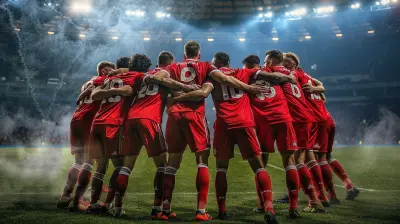
Developing Champions: The High School Programs Shaping the Future
6 August 2026
High school athletics sit at a strange crossroads. On one hand, they are the last bastion of pure, amateur competition. On the other, they have become a high-stakes proving ground for college scholarships, professional drafts, and national recognition. The programs that succeed in this environment are not the ones with the most money or the flashiest facilities. They are the ones that understand a fundamental truth: developing a champion is not the same as developing a winning team. The former takes years; the latter takes a season. The best high school programs in the country have figured out how to do both without sacrificing the integrity of the athlete or the institution.

The Shift from Selection to Development
For decades, the dominant philosophy in high school sports was selection. Coaches waited for talent to walk through the door. They identified the fastest, tallest, and most coordinated kids in the freshman class and funneled them into varsity roles. Everyone else was relegated to junior varsity or cut entirely. This approach worked when the talent pool was deep and the competition was local. It fails now.The modern high school athlete is not born; they are built. The most forward-thinking programs have embraced a development-first model. This means that the varsity coach is not just a tactician on game night but the architect of a multi-year progression. Freshmen are not judged on their current output but on their projected trajectory. Sophomores are given specific physical and technical benchmarks. Juniors are refined. Seniors are polished and prepared for the next level.
This shift is not just philosophical; it is practical. A program that invests in development retains athletes. Retention matters because the best teams are almost always the oldest and most experienced. A school that cuts twenty freshmen every year is bleeding potential. Some of those kids would have become solid varsity contributors by their junior year. But they left to play club, or they quit entirely. The programs that win consistently are the ones that keep their numbers high and their training standards higher.

The Role of the Head Coach as a Manager
The single biggest mistake in high school sports is hiring a head coach who wants to be a tactician instead of a manager. At the professional level, the head coach can focus on Xs and Os because there is an entire support staff handling strength, nutrition, film, and player welfare. High school coaches do not have that luxury. They are often the strength coach, the academic advisor, the equipment manager, and the parent liaison all at once.The best high school coaches understand that their primary job is to build a culture and delegate the rest. They identify assistant coaches who specialize. One coach handles the freshman development program. Another runs the off-season lifting schedule. A third handles film breakdown and scouting. The head coach oversees the whole machine, ensuring that the message is consistent from the freshman team to the varsity team.
This managerial approach has a profound effect on continuity. When a program relies on one charismatic head coach to do everything, it collapses the moment that coach leaves. But when the head coach builds a system with defined roles and responsibilities, the program survives personnel changes. This is why some high schools remain dynasties for decades while others have a good run and then vanish. The dynasties are not built on genius. They are built on structure.

Periodization and the Long Game
Most high school athletes train incorrectly. They peak too early in the season, or they do the same workout in January that they did in July. The concept of periodization, borrowed from Olympic training, is the solution. It involves breaking the year into distinct phases: off-season, pre-season, in-season, and transition.The off-season is for building a foundation. This is when athletes should focus on general strength, mobility, and aerobic capacity. The pre-season shifts toward sport-specific skills and anaerobic conditioning. The in-season is about maintenance and recovery, not pushing new limits. The transition period, often the two to three weeks after the season ends, is for active rest and injury prevention.
Programs that ignore periodization see a predictable pattern: athletes start the season strong, plateau by mid-season, and either get injured or burn out by the playoffs. Programs that follow it see the opposite. Their athletes get stronger as the season progresses. The reason is simple. The body adapts to stress, but only if the stress is varied and followed by recovery. A high school program that treats every practice like a game is a program that will be eliminated in the first round of the playoffs.

Strength and Conditioning: Beyond the Weight Room
There is a persistent misconception that high school strength training is about lifting heavy weights. It is not. It is about building a resilient body that can handle the specific demands of the sport. For a baseball pitcher, that means rotator cuff work and lower body stability. For a distance runner, that means core strength and calf endurance. For a basketball player, that means lateral movement and ankle stability.The best programs use a functional approach. They do not ask a 15-year-old to squat 200 pounds. They ask them to squat properly with their body weight, then add resistance gradually. They emphasize unilateral movements, like lunges and single-leg deadlifts, because most sports are played on one leg at a time. They incorporate plyometrics, but only after the athlete has demonstrated adequate joint stability.
The other critical piece is recovery. High school athletes are not professional machines. They have homework, social lives, and part-time jobs. They also need eight to ten hours of sleep, which most of them do not get. A program that schedules early morning lifts without considering the athletes' sleep debt is a program that is actively hurting its players. The best coaches build recovery into the schedule. They have practices late enough that kids can sleep in, or they schedule off days after particularly intense sessions.
Nutrition and Hydration: The Missing Link
Coaches will spend hours perfecting a playbook, then hand out pizza after a game. This is a massive blind spot. The food an athlete eats is the fuel that determines performance. A high school athlete who eats fast food twice a day will not reach their potential, no matter how good the coaching is.The most effective programs do not lecture about nutrition. They make it easy. They provide pre-game meals that are high in complex carbohydrates and lean protein. They have water bottles available at every practice and mandate hydration breaks. They educate parents, because parents are the ones doing the grocery shopping.
There is a fine line between guidance and overreach. A coach should not be telling an athlete to go on a restrictive diet. That crosses into medical territory and can trigger eating disorders. Instead, the focus should be on basic principles: eat real food, avoid sugary drinks, and never skip breakfast. The goal is not to make every athlete a nutritionist. The goal is to eliminate the obvious mistakes.
The Academic and Emotional Balancing Act
High school athletes are students first. This is not a slogan; it is a legal and ethical reality. The best programs treat academics as a non-negotiable part of the athletic equation. They have study halls for athletes with low grades. They communicate with teachers about travel schedules. They understand that a D in math is a bigger problem than a loss on Friday night.Emotional development is equally important. The pressure to perform, especially for those chasing scholarships, is immense. Programs that ignore mental health are setting their athletes up for burnout. The best coaches create an environment where athletes can talk about their struggles without fear of ridicule. They bring in sports psychologists for workshops. They teach breathing techniques and visualization. They normalize the idea that anxiety is a normal part of competition.
The trade-off here is real. A coach who is too soft will not push athletes to their limits. A coach who is too hard will break them. The sweet spot is a demanding but supportive environment. The coach who says, "I know you can do better, and I am going to help you get there," is far more effective than the one who says, "You are not working hard enough."
The Club vs. High School Debate
No discussion of high school sports is complete without addressing the rise of club and AAU teams. These organizations offer year-round competition and exposure. They also cost money, which creates an equity problem. The best high school programs do not fight the club system. They work with it.A smart high school coach understands that the club coach may have more time for skill development. The high school coach should focus on what they do best: building team cohesion, teaching systems, and managing the emotional dynamics of a group. The two can coexist, but only if there is communication. The high school coach should ask what the club coach is working on and vice versa. There is nothing worse than an athlete being told to run a zone defense by one coach and a man defense by the other.
The downside of club sports is overuse injuries. An athlete who plays 80 games a year between high school and club is at serious risk. The best high school programs monitor their athletes' total workload, not just their own practice schedule. They encourage athletes to take one season off from their primary sport. This is not a sign of weakness. It is a sign of long-term thinking.
Real-World Examples of Program Success
There are hundreds of high school programs that do this well, but certain archetypes stand out. Take a large public school in Texas that produces Division I football players every year. The secret is not the talent. The secret is the freshman football program. These schools have dedicated coaches for the freshman team who run the exact same offensive and defensive schemes as the varsity. By the time a player is a junior, they have run the same plays for three years. They do not have to think. They just react.Contrast that with a school where the freshman coach runs a completely different system. The varsity coach has to spend the first month of every season reteaching fundamentals. That is wasted time. The best programs are vertical. They are aligned from the bottom to the top.
Another example is a small private school that excels in cross country. They do not have the enrollment to compete with big schools, but they win state titles. Their approach is minimalist. They run on soft surfaces to protect joints. They keep the volume low for younger runners. They focus on race strategy and mental toughness. Their athletes are not the fastest in the district, but they are the smartest racers. They win because they execute a plan.
Common Mistakes and How to Avoid Them
The most common mistake is overtraining. Coaches think that more is better. They run two-a-day practices in August and wonder why the team is exhausted by October. The fix is to measure intensity, not just duration. A 45-minute practice that is high intensity is better than a 90-minute practice that is mostly standing around.The second mistake is playing favorites. Every coach has a bias toward the most talented kids. But when a coach treats the star differently, it poisons the culture. The bench players stop trying. The star becomes entitled. The team fractures. The best coaches hold everyone to the same standard, even if the star gets more playing time.
The third mistake is ignoring the role of parents. Parents can be the biggest asset or the biggest liability. The best programs have a parent meeting at the start of the season. They set expectations. They explain the philosophy. They ask for help with transportation, snacks, and fundraising. They draw a clear line that feedback about playing time should go through the athlete first. This prevents the toxic dynamic where a parent confronts a coach after a game.
The Future of High School Athletics
The next decade will bring significant changes. The growth of Name, Image, and Likeness (NIL) deals has already trickled down to high school athletes in some states. This is a double-edged sword. It offers opportunities but also creates unrealistic expectations. The best programs will prepare athletes for this by teaching financial literacy and media training.Technology will also play a bigger role. Wearable sensors can track heart rate, sleep, and workload. Video analysis is becoming standard. But the best programs will use technology as a tool, not a crutch. A coach who relies on a spreadsheet to decide who plays is missing the point. The human element still matters.
There is also a growing push for sport specialization to be delayed. The American Academy of Pediatrics recommends against specializing before age 15. The best high school programs encourage multi-sport participation. An athlete who plays soccer and basketball develops different movement patterns and reduces the risk of overuse injuries. This is not just about physical health. It is about mental freshness. Playing the same sport year-round is boring.
Making the Right Choice for Your Program
If you are a coach or an administrator, the first question to ask is not, "How do we win a championship?" It is, "What kind of experience do we want for our athletes?" The answer to that question will guide every other decision. A program that values winning above all else will cut kids, overtrain, and burn out. A program that values development will have more kids, more fun, and ironically, more wins in the long run.The second question is, "What resources do we actually have?" A small school with one gym and one coach cannot replicate the model of a large private school. That is fine. The best programs work within their constraints. They do not try to be something they are not. They focus on doing a few things exceptionally well.
The third question is, "What is our timeline?" Rome was not built in a day. A freshman class that is developed properly will not peak until their senior year. Coaches who expect immediate results will be frustrated. Administrators who fire coaches after one bad season are sabotaging their own programs. The best programs have a five-year plan.
Conclusion
High school sports are not a miniature version of professional sports. They are a unique environment where young people learn about discipline, teamwork, and resilience. The programs that shape the future are the ones that understand this. They prioritize development over selection. They build systems that outlast individual coaches. They treat the whole athlete, not just the athlete on the field.The challenge is that this approach is not glamorous. It does not make headlines. It does not produce immediate results. But it produces champions in the truest sense of the word. Champions who know how to handle success and failure. Champions who are prepared for college and for life. High school programs that embrace this philosophy will not just win games. They will shape the future.
all images in this post were generated using AI tools
Category:
Next Generation AthletesAuthor:

Nelson Bryant
Discussion
rate this article
1 comments
Abigail Marks
High school programs are the real MVPs, turning fresh talent into future legends. If you think it's just about the trophies, think again. These coaches are sculpting minds as much as athletes. Watch out world, the next generation of champions is coming in hot... and they mean business!
August 9, 2026 at 2:30 AM